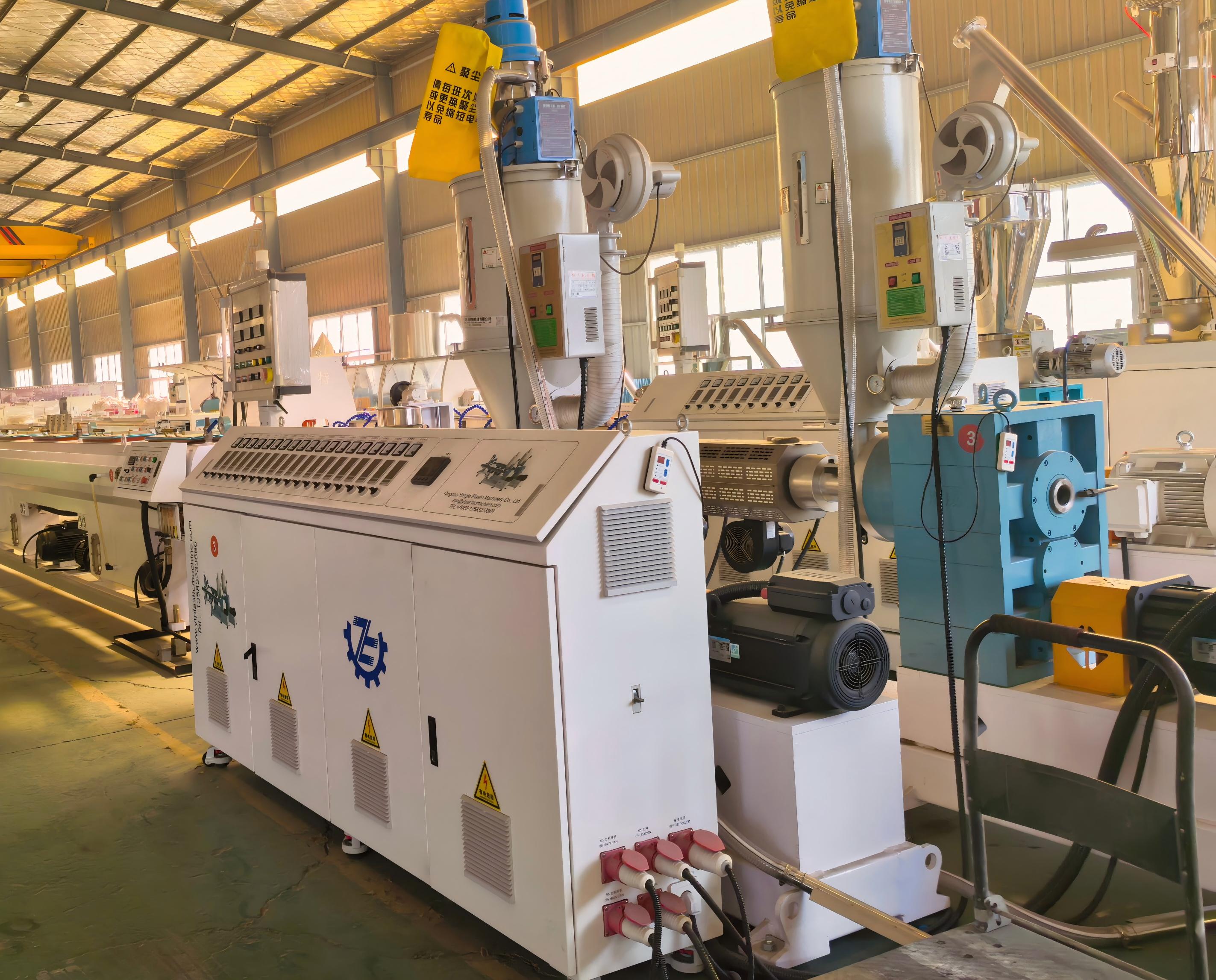

Best Plastic Pipe Machines for Reliable High-Volume Production
2026-10-07
If you've ever watched a high-demand production schedule slip because an extruder couldn't hold tolerances, you know the real cost of 'good enough' equipment. Reliable high-volume plastic pipe manufacturing isn't about luck—it's about machines engineered for endurance and repeatability. This article breaks down the machines that actually deliver on both, including why Yongte has become a name worth checking before you invest.
Hold Tight Tolerances at Full Line Speed
Holding tight tolerances at full line speed isn’t about slowing down to check every part—it’s about building a control loop that responds faster than the process drifts. On high-speed lines, thermal expansion, tool wear, and material variation don’t wait for manual inspections. The only way to stay within a few microns at maximum throughput is to measure continuously and correct automatically, often within milliseconds.
A practical setup pairs in-line laser or vision gauging with automatic offset adjustment at the tooling level. For example, when a bore diameter starts trending toward the upper control limit, the system nudges the boring bar or spindle offset before the next part is machined. This closed-loop approach eliminates the need to stop for periodic sampling, so the line keeps running at rated speed while the dimensional scatter tightens instead of widening.
The payoff shows up quickly in scrap rates and rework hours. Instead of accepting that speed costs precision, manufacturers find that a well-tuned feedback system actually improves both—parts come off the line within tolerance, without the time penalty of off-line inspection or batch sorting.
Feed Recycled Regrind Without Slowing the Extruder
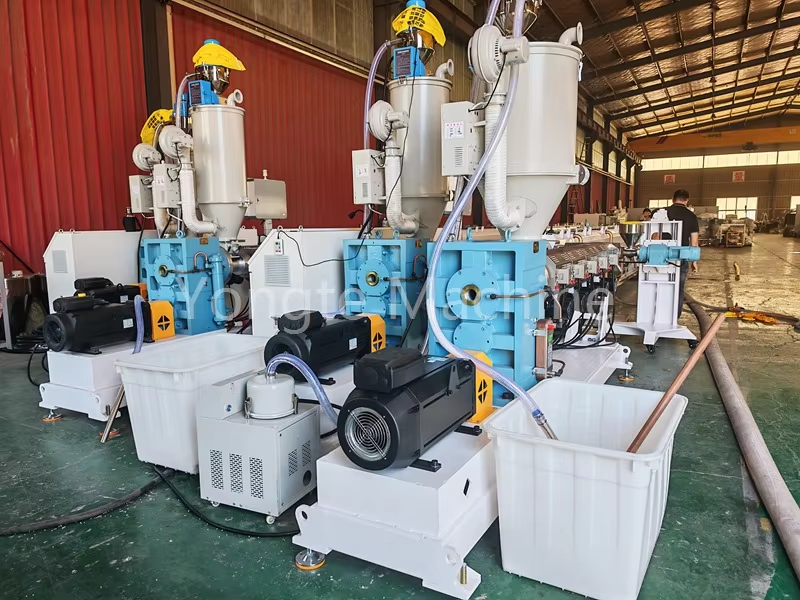
Keeping line speed up when running recycled regrind starts with feed consistency. Regrind often has a lower bulk density and a wider particle size range than virgin pellets, so it tends to bridge in the hopper or slip on the screw. Instead of slowing the screw, add a hopper stirrer or a crammer feeder to keep material moving into the feed throat. Blending regrind with virgin material at a steady ratio also helps maintain a uniform bulk density and reduces feed pulsation.
Particle size control matters more than many operators think. Oversized flakes and fine dust create uneven melting and pressure swings. Screen out anything above the target size and remove excessive fines before feeding. A consistent particle distribution lets the screw flights fill evenly, so you can hold a higher rpm without surging. Preheating regrind slightly—just enough to remove surface moisture and bring it closer to ambient barrel temperature—also lessens the viscosity spike that often forces a speed reduction.
Finally, match the screw and temperature profile to the regrind blend. A screw with a deeper feed section or a barrier design handles low-bulk-density feed better than a general-purpose screw. Keep the rear barrel zone cooler to avoid premature melting at the feed throat, and monitor melt pressure rather than relying only on screw speed. With these adjustments, the extruder can run near its normal rate while still accepting a high percentage of recycled material.
Catch Wall Thickness Drift Before It Creates Scrap
Wall thickness drift rarely announces itself with a single bad part. It starts as a subtle shift in material distribution, maybe a 0.05 mm change that barely registers on the line chart. By the time operators notice a thinning sidewall in a formed container or a weak spot in extruded tubing, the run may have already produced dozens of borderline units. Process engineers who rely only on end-of-line checks are essentially flying blind between samples. Better to watch real-time thickness data from ultrasonic or laser gauges mounted directly after the die or mold. When the average begins trending away from nominal, you can adjust barrel temperatures, screw speed, or air pressure before the deviation becomes dimensional.
The real cost of drift isn't just the scrapped parts you can see. It accumulates in material waste, energy spent remelting or regrinding, and machine time that could have gone to sellable product. A line running thin walls might still pass a quick visual check, but it can fail burst tests or customer audits later. Tracking thickness as a statistical process, with control limits tighter than the part's tolerance band, gives you an early warning window. For instance, if your spec allows ±0.1 mm, set your internal alert at ±0.06 mm and require a documented response. That way, you catch the drift while it's still correctable, not after the profile has walked off the edge.
Simple habits also help. Clean the measurement sensors regularly, because buildup from plastic fumes or coolant mist can create false thickness readings. Record not just average thickness but the minimum wall point, since a part often fails at its thinnest location, not its average. When you do make an adjustment, wait one full cycle or a known lag time before reacting again—overcorrection is a common source of oscillation that mimics drift. With these practices, thickness drift becomes an ordinary process variable to manage, not a crisis that ends the shift.
Run Haul-Offs and Cutters Around the Clock
Keeping haul-offs and cutters running through every shift starts with dialing in belt tension and blade clearance before the first cut of the day. A haul-off that slips even slightly can create wall thickness variation or length drift, while a dull cutter blade quickly turns clean cuts into ragged edges and jammed discharge chutes. Small, scheduled adjustments at shift change often prevent the kind of unplanned downtime that eats into overnight runs.
Around-the-clock operation also means you cannot ignore heat buildup in gearboxes or wear on puller pads. Thermal expansion changes gripping force, so what worked at 2 p.m. may need a tweak at 2 a.m. Build a simple log for temperature, line speed, and cut length, then let operators flag trends before they become alarms. The shift that catches a slowly widening tolerance band is the one that saves the next shift from a pile of scrap.
Finally, stock critical wear items close to the line, but do not let that become an excuse to run components to failure. Change blades on a meter-based interval rather than waiting for visual dullness, and rotate or replace polyurethane pads before they glaze. When changeovers are quick and predictable, running haul-offs and cutters around the clock feels less like a gamble and more like standard practice.
Cut Startup Time With Even Heating and Cooling
Uneven temperature distribution forces many systems to idle longer before they can run safely. When heat spreads quickly and settles evenly, there’s no waiting around for hot spots to cool or cold zones to catch up. That means the machine hits its working range in a fraction of the usual time.
The trick often lies in the airflow or fluid path. Instead of relying on a single heat source that slowly radiates outward, these designs push warmed air or liquid through every corner at once. Cooling works the same way, pulling heat out uniformly so the next cycle can start without delay.
For operators, the payoff is straightforward: less downtime between runs, lower energy waste from idle warming, and fewer thermal shock failures. A system that reaches steady state quickly and cools down evenly doesn’t just start faster—it keeps working longer without hiccups.
Plan Maintenance Around Real Wear, Not Guesswork
Equipment rarely fails on a tidy schedule, yet most maintenance plans still run on calendar days or hours logged. That approach wastes money replacing parts with plenty of life left while letting real stressors go unnoticed. By tracking actual wear patterns—vibration shifts, heat signatures, fluid contamination, load spikes—you can schedule service only when components genuinely need it. This turns maintenance from a calendar-driven chore into a condition-based routine that follows how the machine actually works.
The shift starts with gathering reliable data from each asset. Sensors and routine inspections reveal which parts wear faster under your specific operating conditions, not the manufacturer's averages. Once you know that a bearing lasts 14 months in your dusty environment instead of the generic 18-month estimate, you stop replacing it early. More importantly, you catch the one unit that degrades in 9 months before it takes down a production line. Planning around real wear means fewer unplanned failures, longer asset life, and budgets that reflect reality rather than guesswork.
FAQ
For continuous high-volume output, single-screw extruders with grooved feed zones handle HDPE and PP very well, while twin-screw extruders excel with PVC formulations that need precise heat control. Co-extrusion lines are worth considering if you need multi-layer pipes for added pressure resistance or UV stability.
Use a vacuum sizing tank with multiple chambers and independent pressure control. Pair it with an ultrasonic thickness gauge that feeds real-time data back to the haul-off speed and extruder RPM. Even small fluctuations in melt temperature can cause drift, so keep barrel zones within a 3-5°F window.
Replace screw and barrel wear parts based on actual output hours rather than calendar months. Daily purge the die head, check gearbox oil temperature and filter condition, and inspect haul-off belts for glazing. Keep a log of amp draw on the main motor—spikes often signal impending screw wear.
Look for a gravimetric feeding system that can hold within 0.5% accuracy, an accumulator head or spiral mandrel die for uniform melt distribution, and a haul-off with enough tractive force to handle heavy pipe without slippage. Motorized pipe supports and automatic length cutting reduce labor.
Choose machines with direct-drive extruder motors instead of belt-driven ones—they recover energy during braking and can cut power use by 8-12%. Insulate the barrel and use ceramic band heaters. Also, running the screw at optimal RPM rather than maximum often gives better melt quality and lower kWh per kilogram.
Underestimating cooling capacity is the biggest one—pipes need enough tank length and chilled water flow to solidify before cutting. Skipping material drying for hygroscopic resins like nylon or PET leads to voids. And setting haul-off speed manually instead of linking it to a laser diameter gauge causes ovality.
PVC needs a twin-screw extruder with low-shear screw design and corrosion-resistant barrel. PEX and other crosslinked materials need a downstream crosslinking unit and precise temperature control to prevent premature curing. PP-R requires a special screw geometry for high melt strength and a long cooling bath.
Ask for a documented trial with your specific resin and pipe dimensions, not just a general brochure figure. Check the specific energy consumption (kWh/kg) at that output, and request references from plants running similar pipe sizes for at least 5000 hours. A stable amperage curve during trial is a better indicator than peak output.
Conclusion
In high-volume pipe production, the difference between profit and scrap often comes down to how well a machine holds a wall thickness tolerance when the line is running at maximum speed. The best plastic pipe machines pair rigid screw and barrel designs with closed-loop control on melt pressure and haul-off speed, so ovality and dimensional drift get corrected in real time rather than after a reel of bad product. They also let operators feed substantial amounts of recycled regrind without dropping extruder output. Good venting, a feed throat that stays cool, and a screw geometry that mixes without over-shearing keep the melt homogeneous even as bulk density changes. Adding a non-contact wall thickness gauge or an ultrasonic scanner directly after the vacuum tank means the line can flag a thin spot before it becomes scrap, instead of discovering the problem at the end of a shift.
Reliability in continuous production depends on more than just the extruder. Haul-offs and cutters built with sealed bearings, automatic blade lubrication, and servo-driven clutch systems are meant to run around the clock, not to be the first point of unplanned downtime. Startup is another area where well-designed machines save time: even heating across the barrel zones and a water bath with balanced spray patterns bring the line to stable conditions faster, so the first good pipe appears sooner. Maintenance becomes less guesswork when the control system logs hours on critical wear parts and tracks motor torque or temperature drift, letting technicians replace belts, screws, and blades based on actual use. That combination of tight process control, regrind tolerance, continuous-duty downstream equipment, and condition-based maintenance is what separates a machine that merely extrudes pipe from one that supports dependable high-volume output.
Contact Us
Contact Person: Ms Qin
Email: [email protected]
Tel/WhatsApp: 8613583233866
Website: https://www.yongteplast.com