

China Combined Air Handling Unit Selection Guide for High Performance Buildings
2026-11-20
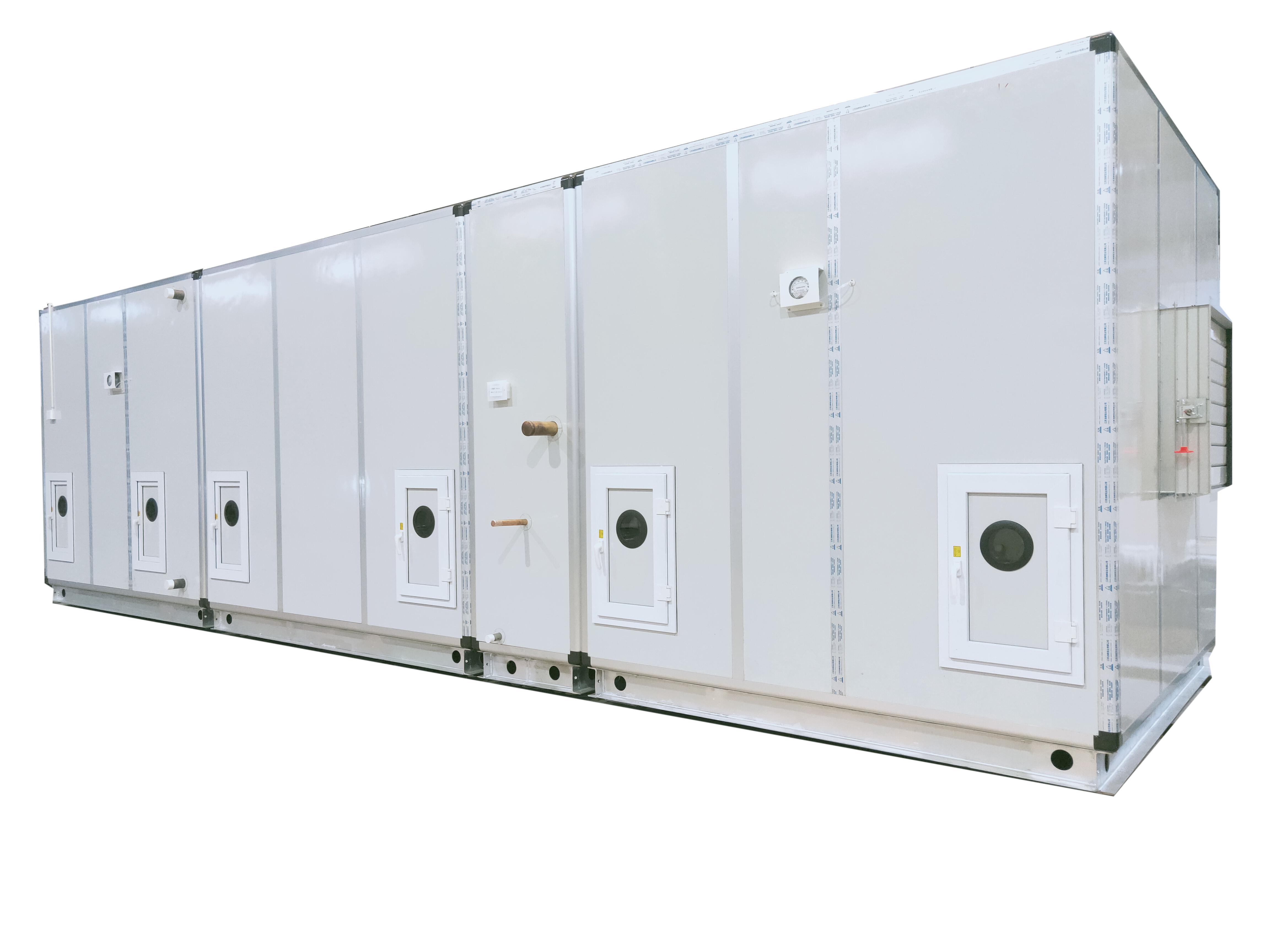
Most AHU selection guides stop at airflow and cooling capacity—yet in China’s high-performance buildings, the real challenge shows up in part-load humidity control, outdoor air swings, and stricter energy codes. This guide moves past catalogue data to compare what actually keeps a combined air handling unit stable, efficient, and serviceable under real operating conditions. It also highlights how ROTER responds to those field demands with designs matched to the load profiles Chinese projects actually face.
Matching Coil and Fan Sections to China’s Regional Climate Extremes
In the humid, almost saturated air of the Pearl River Delta, a coil that performs well in Beijing will quickly become a liability. High latent loads demand deeper row configurations and hydrophilic fin coatings so condensate sheets off instead of clinging and inviting microbial growth. Meanwhile, the fan needs to move denser, moisture-laden air at lower static pressures without hunting or vibrating. Designers often push the air face velocity down and widen fin spacing slightly to keep water from bridging across the fins, which reduces capacity far less than a fouled, dripping coil would.
Move northwest toward Turpan or Urumqi and the picture inverts. Summer afternoons bring dry, scorching air that carries fine dust and pushes sensible heat ratios close to one. Here the coil is less about dehumidification and more about surviving abrasive particles and high temperature differentials. Thicker fin material, protective coatings, and easier access for washing matter more than an extra row of tubes. Fan sections have to cope with lower air density at altitude, so a direct-drive impeller selected at sea level may fall short in Lhasa or Xining unless the motor and blade combination is re-rated for the thinner air.
In the northeast, Harbin and Mohe introduce freeze-thaw cycles that punish coils and dampers left on the edge of the operating envelope. Preheating loops, glycol run-around systems, and drainable coil circuits become essential rather than optional. Fan bearings and belts also need cold-start lubrication ranges that tolerate subzero soak temperatures. Rather than applying a single nationwide unit schedule, engineers match row depths, fin spacing, casing insulation, and fan power curves to the dominant stress of each climate zone: moisture control in the south, dust and altitude in the west, and ice in the north.
Why Dehumidification Loads Shift in High-Performance Chinese Envelopes
In much of China, high-performance envelopes are often evaluated by their ability to cut heating and cooling demand, but that metric can hide a quieter shift in the moisture balance. Once walls, roofs, and windows are upgraded with continuous insulation, better glazing, and tighter air barriers, the sensible cooling load drops sharply. Internal humidity from people, cooking, plants, and drying laundry, however, does not fall at the same pace. In hot-humid cities such as Shanghai, Guangzhou, and Chongqing, the result is an air-conditioning load that looks smaller on paper but carries a much larger share of latent energy, so equipment selected only for peak dry-bulb temperature often runs too briefly to strip moisture from the air.
The shift also reflects how outdoor air behaves in a tightly sealed building. Older Chinese residential and commercial stock leaked enough that incidental infiltration could dilute indoor moisture during dry spells, even if it also admitted humid air in summer. High-performance retrofits and new builds suppress that uncontrolled exchange, leaving mechanical ventilation as the main pathway for outdoor air. If the fresh-air supply is not dehumidified independently, the envelope itself can keep the space cool while the ventilation system continuously imports moisture from outside. That mismatch is especially visible during shoulder seasons and prolonged wet periods, when the sensible load is modest but the outdoor dew point remains high.
Part of the answer lies in how high-performance envelopes change the timing of moisture, not just the total. Concrete, plaster, and gypsum board can absorb moisture when the indoor dew point climbs and release it later as the space cools. In older buildings with leaky frames and oversized cooling, that buffering was easy to miss. In a tight, well-insulated building, the same materials can produce a delayed moisture pulse that keeps relative humidity elevated long after the compressor has cycled off. Dehumidification therefore becomes less of a byproduct of cooling and more of a separate load that tracks occupancy, ventilation, and weather patterns rather than outdoor temperature alone.
Filter Staging for Urban Air and Seasonal Haze in Key Chinese Cities
Effective air quality management in major Chinese cities relies on staged filtration rather than a single control measure. The first stage typically targets coarse dust from construction activity and road resuspension, while intermediate stages concentrate on fine sulfate and nitrate particles that dominate winter haze episodes. This layered approach allows municipal agencies to adjust equipment and operational thresholds as pollutant composition shifts between summer ozone-driven conditions and winter particulate-heavy haze.
Beijing, Chengdu and Xi'an face severe winter inversions, so their staging often prioritizes high-efficiency filters and pre-treatment for secondary aerosol precursors. Coastal centers such as Shanghai and Guangzhou deal with humid, mixed haze and require filter stages that handle both hygroscopic particles and industrial emissions. Seasonal staging also means filtration systems are not run at constant load; they are stepped up during stagnant weather and stepped back when ventilation improves, reducing energy use without sacrificing air quality targets.
Real-time monitoring feeds into the staging logic. Sensors tracking PM2.5, PM10, sulfur dioxide and nitrogen oxides inform when a filter train moves from one stage to the next, allowing rapid response to pollution pulses from crop burning or holiday traffic. In practice, this creates a dynamic sequence where each stage removes a defined fraction of the particle mass, preventing the most penetrating sizes from overwhelming the system during prolonged haze events.
Fan Array Turndown and Part-Load Behavior in Mixed-Use Projects
Mixed-use projects rarely load a fan system the way a single-use building does. A hotel room block might need modest airflow at 2 a.m., a retail level may spike for a few hours around lunch, and an office stack could demand full ventilation only during weekday peaks. Fan arrays earn their place here because they let the air-handling unit turn down in smaller, controlled increments, keeping the supply fan closer to its efficient range instead of forcing one large wheel to throttle back and churn through unstable territory.
The part-load story comes down to staging and isolation. Individual fans in the array cycle on and off around a common discharge plenum, with backdraft dampers or variable-speed drives keeping idle units from becoming leakage paths. At low flow, a couple of fans handle the building while the rest stay off, so the array avoids the surge region that often plagues single-fan selections below roughly half of design airflow. For mixed-use control sequences, that means the central plant can follow actual demand instead of defaulting to a coarse minimum speed that wastes fan energy and makes stable duct static harder to hold.
There are still details that can undermine the expected performance. Air distribution across the plenum shifts as fans stage off, and inactive sections can create uneven face velocities at filters or coils if the layout is not thought through. Low-load commissioning steps should confirm that the remaining fans are not operating too far back on their curves, that outside air dampers still deliver the intended ventilation, and that the plenum does not develop hot or cold spots that show up as comfort complaints later. When those checks are done, the array tends to deliver much flatter part-load efficiency than a comparable single fan.
Heat Recovery Configurations for Heating and Cooling Season Swing
Shifting a dedicated outdoor air system between heating and cooling rarely means flipping a single switch; the heat recovery path has to be rebalanced for what the building actually needs that week, sometimes that day. A fixed-plate exchanger that salvages winter exhaust heat can become a liability in shoulder season when the relief air is cooler than the entering outdoor air, so the bypass dampers and face-and-bypass sections need to work together rather than simply defaulting to full recovery.
For rotary wheels and enthalpy cores, slowing the wheel or opening the bypass can keep midday solar gains from being pushed back into the supply air. Run-around coil systems handle the swing differently: pump speed and three-way valve position are adjusted to trim the glycol loop, allowing some heat to be rejected instead of transferred. In many air handlers, the most useful configuration is a modulating bypass around the recovery device with an outdoor enthalpy or dry-bulb high limit that overrides the winter recovery sequence once the outside air can provide free cooling.
The control sequence matters as much as the physical arrangement. In swing seasons, a building may need morning heating and afternoon cooling, and hunting between modes can wear out actuators or create supply air temperature spikes. A short rolling average of outdoor air conditions plus a deadband between heating and cooling changeover keeps the system from cycling too often. Where heat pumps are involved, the recovery bypass should also be coordinated with reversing valve position and defrost so the ventilation side does not work against the refrigerant circuit during light-load days.
Mechanical Room Access, Noise Control, and Serviceability in Dense Sites
On tight urban infill projects, mechanical rooms rarely get the footprint they need. The access route matters as much as the room itself: a chiller or air handler that clears the door on paper can become impossible to maneuver when a structural shear wall narrows the corridor by six inches. Coordinating removal paths for the largest single component before slab pours has saved more than one project from cutting openings after the fact.
Noise and vibration require a different kind of planning when the mechanical room sits directly under residential units or beside occupied office floors. Floating inertia pads, spring isolators, and lined duct runs help, but the details fall apart without continuity at wall penetrations and pipe hangers. Even small rigid connections can transmit low-frequency hum through the structure, so the isolation strategy has to be reviewed as a continuous path rather than as isolated equipment selections.
Serviceability in dense sites often comes down to whether maintenance staff can actually reach filters, drain pans, and valves without dismantling adjacent systems. Leaving a clear working zone in front of panels and scheduling coil pull space early avoids the common condition where replacement becomes a multi-day demolition event. In compact mechanical rooms, the most useful upgrade is not always larger equipment but more honest clearance around it.
FAQ
In China's high-performance buildings the difference usually shows up in year-round part-load behavior, humidity control, and how well the unit handles local climate and grid stress rather than the rated cooling or airflow on paper. You need to look at coil rows, face velocity, casing leakage, fan efficiency, and the frost strategy for heat recovery during East China's rainy season and northern winters.
Lower face velocity reduces condensate carryover, pressure drop, and fan energy while improving sensible heat ratio and filtration effectiveness. For projects that need tight indoor humidity control such as laboratories, hospitals, or premium commercial spaces, something around 2.0 m/s or below often works better than the older 2.5 m/s rule, even though the unit footprint may grow.
Southern projects need to prioritize dehumidification and continuous part-load operation, sometimes using reheat or a separate dehumidification path. Northern projects need a clear strategy to keep fresh air from freezing coils in winter, so preheat coils, glycol systems, or heat-recovery defrost controls become central. One national template will not fit both.
Heat recovery can sharply reduce cooling and heating plant capacity when large volumes of outdoor air are required. In dense Chinese cities the choice between rotary, plate, or heat-pipe systems should also account for outdoor air quality, contaminated exhaust, and winter frosting risk. Hospitals or laboratories with contaminated exhaust may need non-contact recovery or bypass and purification strategies.
Look at actual operating efficiency rather than nameplate efficiency, choose smoothly adjustable EC motors or high-efficiency variable-speed drives, and confirm the fan operates near its best efficiency point. The system curve should include final filter loading; otherwise real energy use will drift far above the design estimate.
Standards such as GB/T 14294, GB 50736, and public building energy efficiency codes set limits on casing leakage, thermal performance, and fan power per unit airflow. Green building rating systems also reward part-load performance, metering, and indoor air quality, so the selection has to meet both mandatory clauses and the project's certification goals.
Check the service side clearance during selection and make sure filters, coils, and fan sections have workable access. Many Chinese equipment rooms are compact, so double-side access, slide-out fans, or segmented flanged connections can prevent performance loss later from filters that cannot be replaced or coils that cannot be cleaned.
Conclusion
Selecting a combined air handling unit for high-performance buildings across China means treating climate response as a spatial exercise, not a single design point. In the north, coil and fan sections need enough range to handle dry, subzero winters and hot, dusty summers without oversizing for shoulder seasons. In the humid south and coastal cities, the challenge shifts: improved envelopes lower sensible cooling demand but leave latent loads proportionally higher, so dehumidification capacity often drives coil selection more than temperature control. Filter staging becomes equally site-specific, with longer final filter life in cities where winter haze and spring dust demand more aggressive pre-filtration rather than simply adding pressure drop to the fan.
Part-load operation matters as much as peak duty in mixed-use projects, where fan arrays can stage down during evenings and weekends while maintaining stable duct pressure under uneven occupancy. Heat recovery choice should follow the local balance between heating and cooling hours; runaround loops, rotary wheels, and flat-plate exchangers each fit different seasonal swings and cross-contamination limits. On dense urban sites, access and acoustics often determine layout before thermal performance does. Service clearances, filter pull space, and low-radiated noise housings need to be planned early, or the installed unit may perform well on paper but poorly in the mechanical room.
Contact Us
Contact Person: Rhea
Email: [email protected]
Tel/WhatsApp: +8618800560886
Website: https://www.rotorairtech.com