

China Metal Buckle: The Ultimate Guide to Premium Hardware Accessories
2026-11-16
When a bag feels premium or a buckle snaps with satisfying precision, the difference often comes down to one overlooked component—the metal buckle. China has long been the world’s workshop for these small but critical hardware pieces, yet not all suppliers are equal. In this guide, we pull back the curtain on what separates premium China metal buckles from the mass-produced rest, from alloy choices to surface finishes. You’ll discover how brands like Kingming are redefining quality standards, and why choosing the right buckle partner can make or break your next product line.
The Metal Mix That Separates Premium Buckles from Cheap Ones
Most cheap buckles start life as a zinc-heavy alloy, sometimes called zamak, which pours easily and keeps production costs low. The problem shows up later: the metal is brittle, so stress points like the prong or the bar bend and snap after a few months of daily wear. Premium buckles take a different route. They tend to use solid brass or a carefully balanced brass-nickel mix that resists deformation and keeps its shape even when the leather strap pulls hard against it.
You can feel the difference before you even see it. A brass-heavy buckle has a certain weight and a slight warmth when it sits in your palm, while a zinc alloy piece feels hollow and cool, almost like a toy. Over time, the zinc plating on cheap versions flakes to reveal a dull gray core, leaving greenish residue on fabric. Solid brass, by contrast, develops a patina that actually adds character instead of looking worn out.
There is also the matter of the casting. Premium metal mixes are often forged or machined from bar stock, which aligns the grain structure and eliminates microscopic air pockets. Cheap buckles are usually die-cast under lower pressure, leaving tiny voids inside that become weak points. This is why a high-end buckle can survive a decade of use while a bargain one fails at the hinge after the first hard tug.
Casting Plating and Polishing A Walk Through the Production Line
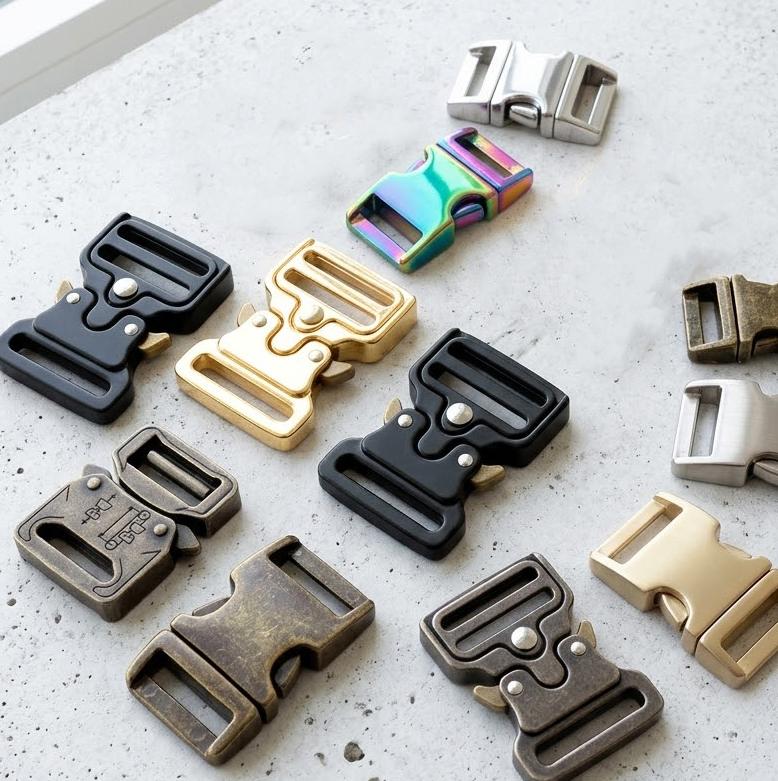
The casting bay runs hot and loud, with molten alloy poured into sand or die molds at a pace set by cooling curves rather than clocks. Operators watch for short pours and gas pockets, trimming flash while the parts are still warm enough to cut cleanly. Small shifts in mold temperature or metal chemistry show up fast as warped edges or surface sinks, so the line adjusts riser placement and pour speed throughout a shift instead of waiting for rejection counts.
From casting, parts move to plating racks where they get degreased, acid dipped, and rinsed in a sequence that leaves little room for skips. The plating baths themselves aren't set-and-forget: current density, anode spacing, and bath temperature are nudged to keep thickness even inside recesses and along edges. A dull patch near a hanging hole often points back to poor rack contact, which is quicker to fix than re-plating an entire batch.
Polishing is where the surface story gets told. Coarse wheels remove casting lines and minor pitting, then finer compounds build up a mirror finish under softer buffs. Inspectors run fingertips over curved areas and hold pieces under angled light, catching scratches that straight-on views hide. The final pass isn't just about shine; it's about making sure the plating underneath hasn't been worn through at corners or edges.
Surface Finishes That Outlast Daily Wear and Weather
Picture a metal chair left on a patio through three scorching summers and a winter of freezing rain. The surface still shows no rust or fading, and the secret isn't the metal itself—it's the invisible barrier wrapped around it. A truly durable finish doesn't just sit on top like a coat of paint; it fuses wear resistance with environmental toughness, so everyday scuffs and seasonal shifts barely leave a mark.
Modern powder coats and anodized layers win against daily abuse because they bond chemically with the substrate rather than simply clinging to it. Powder coating, cured at high heat, creates a shell hard enough to shrug off key scratches, while its dense structure stops moisture from seeping in and corroding the base metal. For wood surfaces, outdoor-grade polyurethane or ceramic hybrid coatings handle both UV rays and the expansion and contraction that come with temperature swings.
When choosing a finish for a patio door or exterior fixture, don't just judge by the shine on a sample swatch. Matte or lightly textured surfaces tend to hide fine scratches far better than high-gloss ones, which reveal every mark. Regular cleaning also beats frequent repainting—these long-wearing coatings need only a simple rinse to look fresh again, saving you from the yearly repaint routine.
Where These Buckles End Up Handbag Straps Belts and Pet Gear
A well-placed buckle on a handbag strap does more than hold the bag together. It lets the strap pivot, adjust, and take the daily strain of being slung over a shoulder or gripped in a hand. The best ones stay quiet, no rattling or snagging, while the leather or webbing moves around them.
On belts, these same pieces shift from accessory to anchor. A buckle has to handle repeated tension without biting into the material or slipping after the first wear. That means edges are rounded, the prong sits deep enough to stay put, and the frame gives just enough to thread easily but not so much that it deforms.
Pet collars and harnesses put the highest demand on hardware. Sudden pulls, rain, mud, and a dog that loves to roll change the equation. Here the buckle has to release quickly in one direction and stay locked in the other, all while keeping its shape against fur and constant motion.
Custom Buckle Orders Low Minimums and Quick Turnarounds
Most buckle suppliers shy away from orders that aren't measured in the thousands. We built our process around the opposite idea. Whether you need fifty pieces for a limited product drop or a few hundred for a regional rollout, the same tooling and attention to detail apply. No inflated setup fees, no minimum quantity games—just a straightforward path from your sketch or reference to a finished metal or plastic buckle that matches your spec.
Speed matters when you're working against a production calendar. Our in-house prototyping and short-run casting lines cut the typical wait from weeks to days. For simple shapes, we can often move from approved drawing to shipped samples in under ten business days. For more complex multi-part designs, we give you a realistic timeline up front and stick to it, with photo updates at key stages so you're never left guessing.
Low minimums shouldn't mean low consistency. Each buckle goes through the same hardness testing, finish inspection, and dimensional checks as a full production run. That means your first fifty pieces feel and function exactly like the five thousand you might order later. No surprises in color, no variation in prong tension—just dependable hardware that lets you focus on the rest of your product.
Durability Checks Salt Spray Hours Load Limits and Thickness Tests
Salt spray hours get thrown around as if they were a universal measure of durability, but the real story is in the coating system. A galvanized bracket rated for 1,000 hours in a neutral salt fog chamber behaves very differently from a powder-coated aluminum part given the same number. What matters is whether the hours match the exposure conditions the product will actually face—road deicers, coastal humidity, or industrial fallout. Without that context, the number is just a lab artifact.
Load limits and thickness tests are where the numbers either hold up or fall apart. Coating thickness gets checked with a calibrated gauge on flat reference points, not edges or corners where builds run thin. Load testing then pushes the finished part beyond its rated capacity to find the first sign of permanent deformation or cracking. A part can pass a salt spray test and still fail at 80 percent of its claimed load if the base metal is undersized or a weld was ground too aggressively.
FAQ
For hardware that needs to hold up, zinc alloy, brass, and stainless steel are the go-to choices. Zinc alloy casts easily into detailed shapes and takes plating well, but it's brittle if knocked hard. Brass gives a warmer tone and resists corrosion naturally, though it costs more. Stainless steel offers the best tensile strength and won't rust even in wet environments, making it ideal for outdoor gear or marine applications. Many factories will suggest zinc alloy for decorative buckles and stainless steel for load-bearing parts.
Serious suppliers run pull tests on the prong and frame, often using a universal tensile machine to measure the force needed to deform or break the buckle. They may also do salt spray testing for plated finishes—48 hours is common, but some buyers ask for 72 or 96 hours for coastal climates. A less obvious test is the fatigue test, where the buckle is opened and closed thousands of times to check the spring bar or locking mechanism. Always ask for a detailed test report, not just a certificate saying 'passed'.
Electroplating is the most common, but the quality depends heavily on the base layer. A good factory will polish the raw casting to remove micro-pores before plating, otherwise you get tiny bubbles that later flake off. For a matte or antique finish, brushing or tumbling with ceramic media works better than paint. PVD coating is pricier but extremely scratch-resistant and won't chip like lacquer. If you want a vintage brass effect, ask for oxidized brass with a clear electrophoretic coat to seal the surface.
MOQs vary widely, but for a completely new mold, expect to order at least 1,000 to 3,000 pieces per design. Some smaller workshops accept 500 pieces if the shape is simple or they already have a similar mold. The mold fee is often separate and can range from $200 to over $1,000 depending on complexity and material. If you're not ready for that volume, look for stock buckles that can be customized with laser engraving or a change of plating color—this usually has a lower MOQ of 200 to 500 pieces.
Beyond the unit price, mold amortization, plating surcharges, and packaging can sneak up on you. If your buckle has a complex logo on the back, the mold may need multiple cavities or a movable slide, which increases cost. Plating costs fluctuate with metal prices—nickel and chrome surcharges are common. Also, if the buckle is heavy, air freight becomes uneconomical; sea freight is cheaper but adds 20 to 40 days. Some factories quote without the spring bar or screw, so confirm what exactly is included.
Look for three things: a history of exporting to your region, a willingness to share third-party test reports, and clear communication about production timelines. Ask for a pre-production sample, then order a small trial batch of 100 to 200 pieces before committing. Check how the factory handles defects—do they have a written policy for replacement or refund? A factory that avoids video calls or won't let you visit may be hiding inconsistent quality. Smaller, specialized hardware workshops often beat huge general factories in attention to detail.
In luxury bags and belts, the buckle is often the first thing a customer touches, so its weight, finish, and logo clarity signal quality. A cheap, lightweight buckle can undermine an entire product. For outdoor gear, the buckle must withstand repeated stress, UV exposure, and temperature swings—so designers choose acetal or stainless steel with reinforced prongs. In both cases, a well-made metal buckle adds perceived value far beyond its cost, which is why premium brands obsess over tolerances as small as 0.1 mm.
Conclusion
Most people never notice the alloy until a buckle snaps or corrodes. Premium China metal buckles start with a carefully balanced zinc or brass mix—sometimes with a higher copper ratio for tensile strength—so the casting doesn't turn brittle after plating. In the production line, molten metal is injected under controlled pressure, then each piece goes through vibration deburring, electroplating, and a final hand-polish pass. What separates the best is not just the mirror finish but how the surface holds up: a real weather-resistant coating might include nickel underlayers followed by chrome or antique brass, sealed to resist sweat, salt air, and UV fading.
These buckles end up on handbag straps, belts, dog collars, and tactical gear, where failure isn't an option. Factories that cater to hardware brands often accept custom orders with low minimums—sometimes just a few hundred pieces—and turn samples around in under two weeks. Before shipping, serious suppliers run salt spray tests for 48 to 96 hours, load limits well above the rated use, and thickness checks on plating with X-ray or coulometric instruments. If a supplier can't show those test reports, the price difference is meaningless. That's the real guide to premium hardware—details measured in microns and hours, not just catalog photos.
Contact Us
Contact Person: Jamie Zeng
Email: [email protected]
Tel/WhatsApp: +86 13728219269
Website: https://www.kmhardware.com