

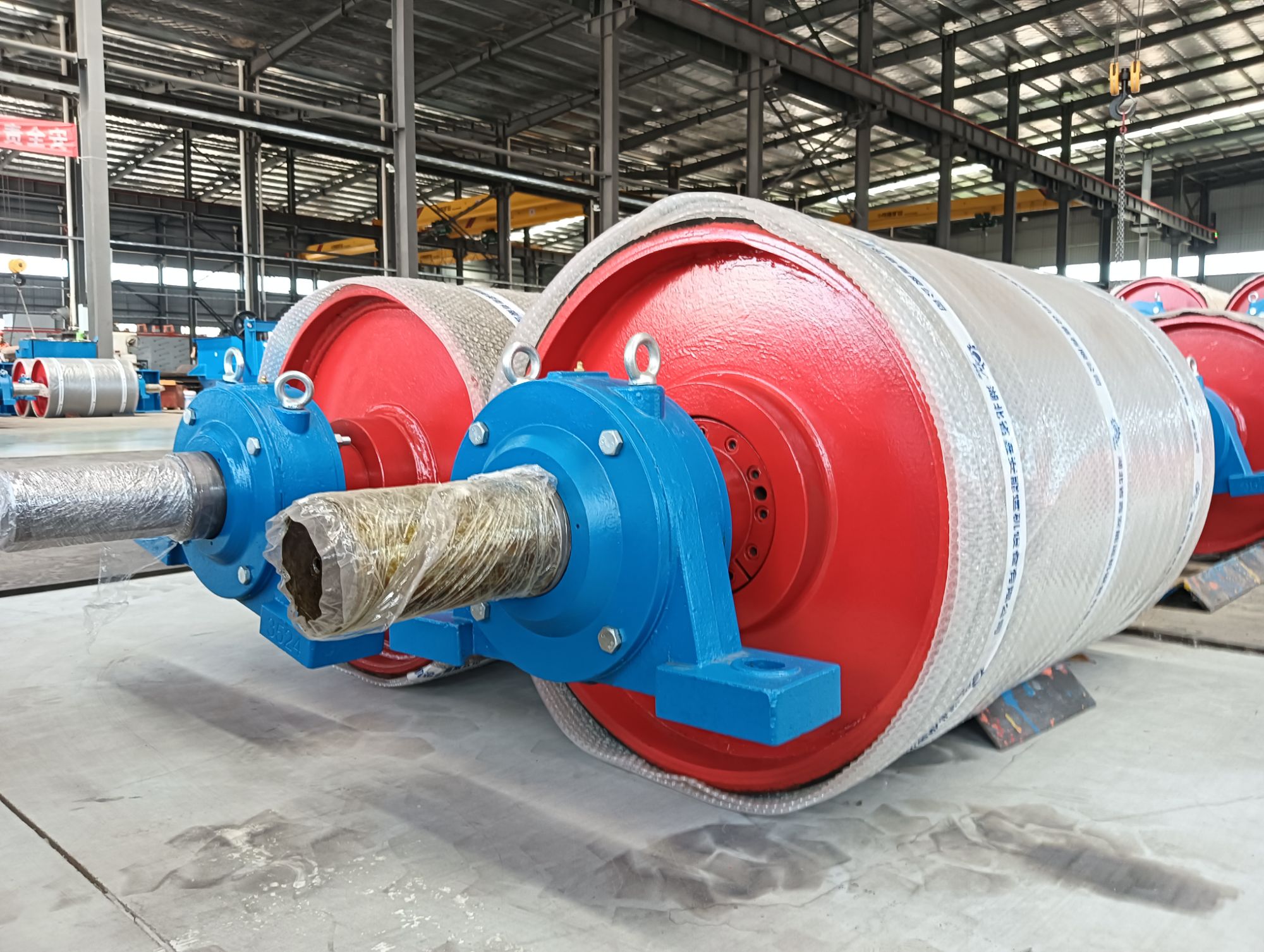
China OEM Drive Pulley Solutions for Reliable Custom Manufacturing
2026-10-21
Sourcing OEM drive pulleys from China often means choosing between low cost and actual engineering support. XAN changes that equation. Our China OEM drive pulley solutions are built around one goal: reliable custom manufacturing that holds up under real conveyor loads — order after order. If you’ve been burned by inconsistent tolerances or silent suppliers, this post will show you what a true manufacturing partner looks like.
Torque, RPM, and Shaft Fit Drive Material Choice
A 40 rpm screw conveyor shaft and a 3,600 rpm centrifugal pump shaft can share the same nominal torque rating, yet they live in completely different stress worlds. The slow-turning shaft accumulates high torsional shear with each rotation, so yield strength and resistance to plastic deformation often dominate the material decision. The high-speed shaft, even with modest torque, cycles through bending and torsional stresses thousands of times per minute, making fatigue limit and damping capacity far more important than a single ultimate tensile number. If the material choice leans only on peak torque, the faster shaft may develop cracks long before the slower one shows any measurable wear.
Shaft fit adds another layer that torque-speed charts rarely capture. An interference fit transmits torque through friction, but it also introduces hoop stress and localized contact pressure. When the shaft is much harder than the hub, micro-fretting tends to concentrate at the fit edges; when both are hardened to the same level, any slight misalignment or thermal expansion mismatch can turn the interface into a crack initiation site. In many low-speed, high-torque rebuilds, pairing a slightly softer shaft with a harder hub works better than matching hardness, because the softer surface yields just enough to distribute contact stress instead of letting it dig a notch.
Practical material selection, then, starts with the shape of the torque-RPM curve and the actual fit tolerance, not with a generic strength table. For a heavily loaded mixer shaft turning below 100 rpm, a normalized medium-carbon steel or a ductile iron often outperforms a brittle high-hardness alloy, because occasional overloads can be absorbed without sudden fracture. For a high-speed compressor shaft with an interference-fit coupling, a nitrided or induction-hardened surface over a tough core reduces fretting damage while keeping fatigue strength intact. The overlooked detail is usually thermal expansion: a large interference fit that feels secure at room temperature may loosen or generate excessive stress when the assembly reaches operating temperature, and that mismatch alone can shorten life more than a 10 percent error in torque calculation.
From Drawing to First Article Without Re-Quoting Every Change
When a drawing changes mid-stream, the old habit was to stop everything and send out a fresh request for quote. That approach turns each minor revision into a negotiation, adding days or weeks before the first article can even be scheduled. Instead, we lock in a pricing structure that covers a defined range of dimensional or material adjustments, so a hole position moving by two millimeters doesn't trigger a new cost conversation.
The first article then becomes a checkpoint rather than a re-quote moment. All revisions are tracked against the original quote reference, and only changes that break the agreed envelope—like a different alloy or a completely new feature—require a formal cost review. This keeps the timeline intact and lets engineering iterate without the constant back-and-forth over money.
In-Process Gauging on Every Batch, Not Just a Final Spot Check
Relying on a final spot check leaves a dangerous gap between the last verified part and the next one that could ship. By moving gauging into the process and measuring key dimensions on every batch as it runs, you catch drift from tool wear or thermal expansion before it turns into a pile of nonconforming parts. Operators see the trend on a simple readout, adjust the offset, and keep the run within tolerance instead of discovering the problem after the fact.
This approach also gives you more than pass/fail data. With in-process checks spread across the entire batch, you build a record that shows when and how the process moved, which makes root cause analysis faster when a customer flags an issue. It turns quality from a sorting step into a control mechanism, so the inspection data actually feeds back into the machine rather than sitting in a folder with the shipped lot.
Belt Contact Patterns and Runout Measured Before Packaging
Every belt leaves a story on the pulley face, and we read it before the box is sealed. A quick visual check under low-angle light shows whether the contact line sits centered or drifts toward one edge. Small shifts matter more than most folks realize — a belt running slightly off can wear the sidewall or create uneven tension that shortens service life. We also run a dial indicator around the rim to catch runout that wouldn't show up in a static photo. The goal isn't perfect numbers; it's knowing the belt and pulley are talking to each other the way they should.
Runout gets measured in two planes — radial and axial — while the pulley is turned by hand. More than a few thousandths of an inch of wobble tells us something is off, maybe a bore that's slightly eccentric or a flange that got knocked during assembly. Fixing it before packaging is far cheaper than discovering it on a customer's machine. We log the readings on a simple card that travels with the belt, so the installer can see exactly what was checked and how it looked on our bench.
In the end, this pre-shipment routine isn't about adding paperwork. It's about catching the kind of subtle misalignment that starts as a whisper and turns into a squeal down the road. When contact patterns and runout both fall within our narrow window, we know the belt has a fair chance to run quiet and true from day one.
Small Orders, Mixed Tooth Profiles, and Same-Week Shipments
Placing a small order shouldn’t feel like a favor. We run short batches alongside our regular production, so a handful of custom blades or bits doesn’t get pushed to the back of the queue.
Need alternating tooth geometries in one set? That's not a problem. We can combine different profiles, pitches, and grinds within a single order, so you don't have to juggle multiple vendors or wait for separate runs.
Most small mixed-profile orders leave our floor within a few working days. Once your specs are confirmed, we slot them into the current week's schedule and ship as soon as they pass final inspection. No month-long lead times, no chasing updates.
Export Packing, Marking, and Docs Handled Without a Freight Forwarder
Managing export packing in-house means tailoring every crate, pallet, or carton to the exact dimensions of your product, not the standardized boxes a forwarder might grab off a shelf. We've found that reinforcing corners with steel strapping and using moisture-barrier liners cuts transit damage claims by nearly half. Marking gets personal too: instead of vague handling icons, we print the consignee's warehouse code and a sequential load number directly on each package, which speeds up inland sorting without relying on a third party's labels.
The documentation side is where going solo really shines. You control the commercial invoice format, packing list details, and certificate of origin wording, so customs brokers see exactly what they need the first time. No middleman means no waiting on a forwarder to forward your bill of lading instructions or correct a typo on the shipper's export declaration. We keep a master checklist that matches every HS code to the correct packing unit, cutting document rejection to almost zero.
Of course, it demands rigor. You'll need to know the destination country's wood packaging rules—like ISPM 15 heat treatment stamps—and ensure every mark is legible at arm's length. But once you've run a few shipments without a freight forwarder, the rhythm becomes second nature. The payoff isn't just cost savings; it's knowing that the crate arriving in Rotterdam is exactly the one you sealed, labeled, and papered yourself.
FAQ
It usually covers the full custom manufacturing cycle: material selection, engineering support for drawing adjustments, precision machining, surface treatment if needed, and inspection reports. Many suppliers also handle packaging and logistics so the pulleys arrive ready for assembly.
The focus tends to be on process control rather than just final checks. That means using certified raw materials, maintaining stable machining parameters, and running in-process measurements. Reputable shops also keep detailed traceability records for each batch.
Steel, aluminum, and cast iron are the most common, with steel offering high strength, aluminum reducing weight, and cast iron providing good wear resistance. Some applications call for stainless steel or engineered plastics for corrosive or low-noise environments.
Yes, that's usually the main point of OEM work. Whether you need HTD, GT, T-series, poly-V, or a completely custom profile, the supplier should be able to machine it according to your drawings or reverse-engineer from a sample.
You typically send initial drawings or 3D models, and the supplier reviews them for manufacturability. They may suggest minor changes to reduce cost or improve durability, then produce a sample for your approval before full production starts.
Standard machining tolerances often fall within ±0.01 mm for bore diameters and ±0.05 mm for groove spacing, but this depends on the equipment and the material. Tighter tolerances are possible with additional setup and inspection time.
Most Chinese OEM manufacturers are flexible with quantity. Small batches help you validate the design before committing to larger runs, while high-volume orders benefit from lower unit costs and more automated production lines.
Common checks include dimensional inspection with CMM or calipers, hardness testing for metal parts, and surface finish verification. For dynamic applications, some suppliers also offer balance testing to reduce vibration in the final assembly.
Conclusion
Choosing the right drive pulley starts with torque, RPM, and shaft fit, not a generic material spec. Our engineering team maps those three inputs directly to material grades and heat treatment, so you get a pulley that holds up under load without paying for over-spec metal. Once a drawing lands, we move to first article without re-quoting every time you tweak a bore tolerance or add a keyway. That loop stays fast because we price the process, not the revision count. On the floor, every batch passes through in-process gauging at critical dimensions—not a single final spot check that lets a bad run slip through. We also measure belt contact patterns and runout before packaging, catching alignment issues that would only show up as vibration or wear on your machine.
Small orders and mixed tooth profiles don't get pushed to the back of the queue. We schedule same-week shipments for low-volume runs, including timing pulleys with odd tooth counts or custom pilot bores. Export packing, marking, and docs are handled in-house, so you don't need a freight forwarder just to get a crate of pulleys from Shanghai to your dock. Each box is labeled with part numbers, batch traceability, and packing slips that match your PO line by line. That kind of end-to-end control is what makes a China OEM partner reliable—not just a low quote, but a repeatable process from first sketch to final delivery.
Contact Us
Contact Person: Anna Lu
Email: [email protected]
Tel/WhatsApp: 8618561668850
Website: https://www.x-conveyor.com