
Custom Karate Uniforms for Personalized Fit and Superior Movement
2026-09-21
Off-the-rack karate uniforms rarely move the way you do. They bunch at the shoulders, pinch at the waist, and restrict the very techniques you’ve spent years perfecting. At PandaWin Sports, we believe your gi should be an extension of your body, not a barrier. Our custom karate uniforms are tailored to your exact measurements, delivering a personalized fit and superior freedom of movement from the first bow to the final strike. Read on to discover how a truly custom gi can transform the way you train.
Why Most Karate Uniforms Restrict Your Movement
The traditional karate gi, while steeped in history, often falls short when it comes to natural range of motion. The straight-cut sleeves and stiff, heavy cotton fabric can bind at the shoulders and hips, making high kicks, deep stances, and rapid hand techniques feel more like a wrestling match with your own clothing. Students frequently find themselves tugging at their jacket or adjusting their belt because the uniform simply wasn't designed with dynamic, multi-directional movement in mind.
Many gis are also cut with a uniform width from chest to hem, ignoring the fact that the human body tapers and twists. This creates excess fabric that bunches at the waist during side bends or cross-body strikes, while the shoulders stay tight and restrictive. Add in a thick, unyielding belt knot that digs into the stomach during floor work, and you have a recipe for distraction and limited performance in the dojo.
What's more, the traditional drawstring waist and minimal gusseting mean the pants can slide down or pull against the legs during deep kiba dachi or sudden direction changes. The result isn't just discomfort—it's a hidden brake on your speed and precision, forcing you to fight the uniform instead of focusing on your technique.
Measuring for a Gi That Fits Like It Was Made for You
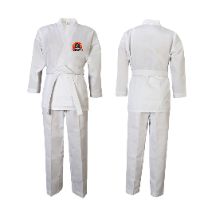
A gi that feels like it was cut for your body starts with three numbers: chest, wingspan, and inseam. Measure over a rashguard or thin shirt—never over bulky layers—and use a soft tailor's tape, not a metal ruler. For chest, run the tape under your armpits across the widest part of your back and chest. Wingspan is fingertip to fingertip with arms stretched out to the sides; this matters more than height because sleeve length controls how easily opponents can grip your cuffs. Inseam runs from the crotch seam of well-fitting pants down to the ankle bone, and it determines whether your gi pants will puddle at your heels or break cleanly over your instep.
Shrinkage is not a flaw—it is part of the process, so measure with post-wash fit in mind. Most cotton or cotton-blend gis will lose anywhere from one to three inches in the sleeves and pants after the first few hot washes and tumble dries. If your raw wingspan puts you between an A1 and A2, lean toward the larger size and shrink it down gradually. Wash cold and hang dry if you want minimal change; wash hot and machine dry if you need to pull the fabric tighter around your frame. Record your measurements before and after each wash cycle until the gi stops moving, then you will know exactly how that brand behaves.
Fit preference is the final variable that generic size charts ignore. A competition-cut gi sits closer to the skin and leaves less material for opponents to grab, but it can restrict deep knee cuts and high guards. A roomier training gi gives you freedom to move but may become a handle in live rolls. Sleeve cuffs should stop right at the wrist bone when your arms hang straight; if they ride up mid-forearm, grips come too easily, and if they swallow your hands, you will fight your own fabric. For pants, the hem should brush the top of your foot without dragging on the mat. Try the gi on, move through a full squat and a shoulder roll, and trust how it feels over what the tag says.
Choosing the Right Fabric Weight for Your Training
Fabric weight isn't just a spec on a label—it directly shapes how your training gear performs. Lightweight fabrics, typically under 150 gsm, let air move freely and dry fast, making them ideal for high-sweat sessions like HIIT or summer runs. Heavier options above 250 gsm add structure and warmth, which suits strength work in cooler gyms or outdoor sessions when the temperature dips.
Think about your primary training environment before committing. If most of your workouts happen indoors with climate control, a midweight fabric around 180–220 gsm offers a balanced feel—enough coverage without overheating. For outdoor athletes, layering becomes easier when you choose a base layer in a lighter weight and add a heavier outer piece as needed.
Durability is another factor tied to fabric weight. Ultra-light materials can snag or wear out faster if you're dragging a barbell across your thighs or doing ground work. A slightly heavier knit often resists abrasion better, so if your training involves rope climbs, sled pushes, or mat-based mobility, lean toward the heavier end of the scale.
How Custom Sleeve and Pant Lengths Improve Your Stances
When your sleeves stop at the wrist bone instead of swallowing your hands, every small shift in your forearm becomes visible. That visibility matters more than most people expect—your brain reads the line of your arm against your torso to judge whether your shoulders are truly square. Extra fabric pooling at the cuff blurs that signal, and you end up overcorrecting without knowing why.
Pant length plays a similar trick from the ground up. Hemming trousers to just kiss the top of your shoe keeps the ankle line clean, so your stance feels planted rather than muffled. Fabric bunching around your feet pulls your attention downward and subtly alters how you distribute weight. A clean break at the shoe lets you settle into your hips and knees without fighting the cloth.
Reinforced Stress Points Without Stiffness
The usual trade-off with added durability is a stiff, board-like feel, but these stress points are reinforced in a way that lets the material keep moving. Instead of broad patches, the construction relies on tightly mapped zones where high-wear areas get extra yarn density or thin overlays only along the actual stress lines.
That means high-wear areas like heel counters, toe caps, and side panels get built up with abrasion-resistant thread and segmented films rather than a single thick layer. Small flex gaps between the reinforced zones act like natural hinges, so the material folds along the same lines it would after repeated use. Protection holds without flattening range of motion or creating pinch points.
Repeated wear testing showed the reinforced sections hold up without cracking or delaminating, while surrounding material stays pliable enough to fold and twist without resistance. It's the kind of detail you notice only when you realize there's no break-in period—just immediate comfort with hard-wearing areas already where they need to be.
Design Details That Match Your Dojo and Your Body
Every cut of your gi tells a story before you step onto the mat. The shoulders, sleeve width, and jacket length aren't random measurements—they're shaped by the way you move, the throws you favor, and the rhythm of your own breath under pressure. A well-fitted uniform follows the line of your frame without choking your mobility, letting you sink into a low stance or twist into a reversal without fighting your own clothes.
Weight and weave matter just as much as silhouette. A heavier fabric can anchor you during grip fighting, but it also traps heat in a crowded training hall. Lighter weaves breathe easier but may slip more in a scramble. The trick is knowing your dojo's climate and your own sweat profile, then choosing a weave that keeps you focused on your technique instead of adjusting your collar.
Finally, small details you rarely notice on a rack make the difference after a hundred hours of training. Reinforced knees that bend without bunching, a lapel that stays flat under pressure, cuffs that don't ride up when you reach for a collar tie—these are the quiet upgrades that turn a generic uniform into a second skin. When the design matches both your dojo's energy and your body's quirks, you stop thinking about the gi entirely and just train.
FAQ
An off-the-rack gi is built around generic sizing, so you often end up with sleeves that are too long or pants that bunch at the waist. A custom uniform starts from your actual measurements and adjusts the cut to your body, which means less fabric fighting you during techniques.
When the shoulders, chest, and inseam are tailored to you, the fabric moves with your body instead of against it. You get a full range of motion for high kicks, deep stances, and quick direction changes without the jacket riding up or the pants dragging.
Most makers ask for chest, waist, hip, arm length, shoulder width, and inseam. Some also want wrist and ankle circumference if you prefer a tapered sleeve or pant leg. They’ll usually provide a simple guide so you can measure yourself at home.
Yes, that’s one of the biggest advantages. You can go with a light, breathable cotton for summer training, a mid-weight brushed cotton for everyday comfort, or a heavier canvas-style weave for more snap and durability.
It depends on the workshop and their current queue, but most custom orders take between two and five weeks from measurement to shipping. If you need it faster, some makers offer rush options for an extra fee.
Not really. You still wash it in cold water and hang it dry to prevent shrinkage. The main difference is that because it fits you correctly from the start, you don’t have to rely on hot water or a dryer to shrink it down to size.
A good custom maker will leave a little seam allowance in key areas like the waist and hips, so the uniform can be let out or taken in slightly. If the change is dramatic, you may need a new jacket or pants, but minor adjustments are usually possible.
Anyone who spends multiple hours a week in a gi can benefit. If you’re constantly adjusting your sleeves or retying your pants, a custom fit removes those distractions, so even a beginner or recreational student will feel the difference.
Conclusion
Most off-the-rack karate uniforms force you into a compromise: the shoulders pull when you chamber a punch, the hips bind when you drop into a deep stance, and the sleeves ride up just as you need full extension. A custom gi eliminates that struggle by starting with your actual measurements, not a generic size chart. When you measure the distance from your shoulder to your wrist, the circumference of your chest, and the length from your waist to your ankle, every panel falls where it should. This precision matters even more when you factor in fabric weight. A lightweight cotton blend might keep you cool during summer sparring, while a heavier canvas gives you that satisfying snap and durability for daily practice. The key is matching the cloth to how you train, not how a manufacturer thinks you should.
Beyond the basic fit, custom options let you adjust sleeve and pant lengths to support your stances. Extra length in the trousers prevents them from hiking up in kiba dachi, and a slightly tapered sleeve won't bunch at the elbow during a straight punch. Reinforcements at the knees, lapels, and side vents can be added without making the fabric stiff, because the right stitching pattern distributes stress rather than concentrating it. Finally, small design choices—like a shorter jacket for a modern dojo or a traditional embroidery placement—make the uniform feel truly yours. The result is a gi that moves with you, resists wear where you need it, and reflects both your body and your training environment.
Contact Us
Contact Person: Fei Xu
Email: [email protected]
Tel/WhatsApp: +8618631245578
Website: https://www.pandawinsports.com/