

Giant Press Brake Company Drives Precision Metal Forming with Advanced Bending Technology
2026-11-18
When Giant Press Brake Company set out to raise the bar for precision metal forming, they didn’t just upgrade a machine—they rethought how bending technology should perform under real shop-floor pressure. The result is a process that turns complex bends into repeatable, low-scrap results, without forcing fabricators to choose between speed and accuracy. In this post, we look at the key decisions behind that shift and what it means for manufacturers chasing tighter tolerances. Along the way, we’ll also see why teams increasingly turn to HUNSONE for bending solutions that hold up when the job gets demanding.
How Giant Press Brake Company Holds Tolerances Other Shops Avoid
Most shops treat tight bend tolerances as a gamble: run a few test pieces, adjust the back gauge, hope the material hasn't shifted with the morning temperature. Giant Press Brake Company removed that guesswork by mapping every variable that shows up on the floor. Instead of relying on a single correction factor, their setup process accounts for grain direction, thickness variation within the sheet, tooling deflection under load, and even the way a batch of steel relaxes after forming. That level of detail lets them hold angles and flange lengths that would normally get quoted as best-effort somewhere else.
The difference also comes down to how the machines are loaded and checked. Rather than pushing a press brake to its rated tonnage and fighting springback on the fly, they stay inside a narrow window where the ram position, crowning, and back gauge repeat within microns. Operators log actual thickness and hardness before the first hit, then compare the formed part against a reference scan instead of a hand protractor. When something drifts, they know whether it is the material, the tooling, or thermal growth in the frame, so corrections happen before a bad part leaves the cell.
That consistency is not reserved for prototype runs. The shop keeps the same discipline on high-mix, low-volume work, which is where tolerance usually collapses. By treating setup as a measured process rather than a skill that depends on who happens to be at the machine, they produce parts that fit the same fixture at 7 a.m. and after lunch. It is not magic; it is just the unglamorous work of recording what actually happens and refusing to accept drift as normal.
What Advanced Bending Control Does Differently With High-Strength Sheet
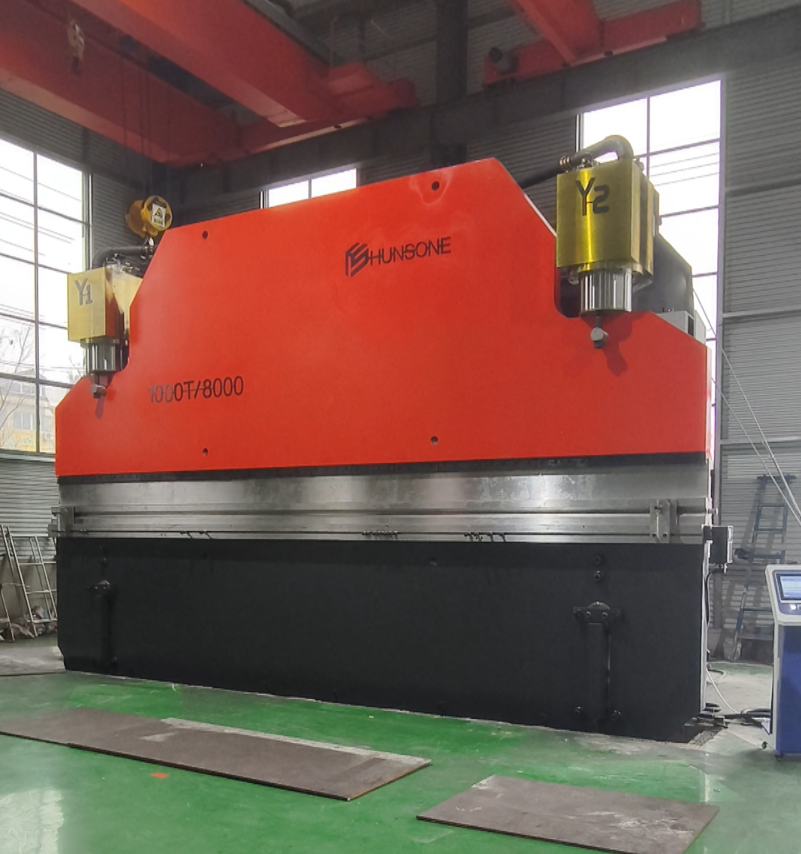
High-strength sheet does not respond to the same bend commands the way mild steel does. It springs back harder, it can twist slightly across the width, and the point where it actually yields shifts from batch to batch. Advanced bending control handles this by measuring the bend as it happens instead of relying on a fixed stroke. The control watches the load curve and the angle sensor together, then adjusts the ram in real time before the final bottoming point.
What really changes is the timing of corrections. Rather than overbending a part and hoping springback lands in tolerance, the system uses a short hold near the target angle to let the material settle, reads the remaining error, and makes a second small correction. This catches variation from surface hardness, grain direction, or thickness drift early enough to avoid a scrapped piece.
The net effect is less trial bending on new material. The control stores the correction pattern for each tool setup and material class, so a repeat job starts from something close to the real bend allowance. It is less about applying more force and more about knowing when to stop pushing.
The Tooling Variables That Quietly Shift Bend Angles
A bend angle rarely drifts because the program says so. More often, the culprit sits in the tooling stack itself—an older punch with a slightly rounded nose, a die opening that has worn a few thousandths wider, or a ram that repeats differently under thermal growth. Those small changes shift how the sheet meets the shoulders and how local strain concentrates, so the same nominal angle comes out a fraction off.
Die clearance and punch radius tend to get treated as fixed values, but they are not. When a die shoulder radius grows from repeated loading or a punch tip picks up uneven wear, the material wraps around a different geometry than the original setup assumed. That changes springback just enough to move the bend by half a degree or more, especially in high-strength or thin-gauge stock.
Clamping pressure, tool alignment, and even uneven lubrication across the punch face play a quieter role. If the blank slips a few hundredths of an inch before the bend settles, the angle shifts without any alarm on the controller. The fix usually is not a new recipe; it is measuring the tooling as it runs, not as it was installed.
Why Springback Stays the Biggest Challenge in Precision Forming
Springback refuses to behave like a simple correction factor because it shifts with every variable on the floor. A change in coil temper, a few degrees of tool temperature, or slight variations in blank thickness can move the final angle enough to scrap a part that measured perfectly yesterday. In precision forming, tolerances often sit within a few microns, while elastic recovery alone can swing dimensions by several times that amount. The material is never fully plastic during bending; there is always a stressed core that wants to relax, and that stored energy releases unevenly once the punch retracts.
The deeper problem is compensation. Die designers can overbend or twist a profile to anticipate springback, but the correction works only for one narrow set of conditions. Advanced high-strength steels and aluminum alloys make the math worse because they carry higher yield strengths relative to their modulus, so the elastic strain component grows even when total deformation looks stable. Add in the Bauschinger effect, where reverse loading softens the material after initial forming, and the final shape becomes a product of loading history rather than a single predictable springback angle.
That is why trial-and-error still dominates. Simulation narrows the guesswork, but no model captures every batch-to-batch shift in lubrication, grain size, and residual stress. Operators compensate with shims, pad pressure, and secondary restrikes, yet each adjustment can create a new distortion elsewhere. Until forming processes can sense and correct the relaxation in real time, springback will remain the bottleneck that separates a stable production run from a stack of near-miss parts.
Where Faster Setup and Consistent Bends Actually Come From
Setup speed rarely comes from a single clever mechanism. It builds up from small, repeatable details: stops that return to the same position without re-measuring, clamp blocks that drop into machined pockets instead of sliding along slots, and tooling that seats against a fixed reference edge. When those points are stable, changing from one part to the next feels less like reconfiguring the machine and more like following a short checklist.
Consistency in bends has less to do with raw force and more to do with what happens around the bend zone. A rigid support close to the die, a clamp that grips without shifting under load, and tooling that stays aligned after repeated cycles keep the material from finding its own path. Even small movement at the clamp or support can turn into visible angle variation, so the machine frame and tool mounting have to be stiff where it actually matters.
The real source is often the removal of operator guesswork. Graduated scales that are easy to read, preset angle stops that do not drift, and a control layout that does not hide common adjustments behind menus all shorten the time between picking up the part and making the first good bend. When those everyday controls are direct and predictable, faster setup and repeatable results stop being a technique and become a property of the machine.
What Precision Metal Forming Demands That Standard Bending Cannot Deliver
Standard bending treats metal like a flexible sheet, forcing it around a punch with a predictable springback allowance. Precision metal forming starts from a different assumption: the grain direction, residual stress, and local thinning near the bend line are not minor variables but the entire problem. A tight-radius bend that looks acceptable on a drawing can tear or distort when the material's rolling direction runs parallel to the bend axis. Precision work reads the blank's history, not just its thickness.
What separates the two approaches is the tolerance for dimensional drift. Conventional bending may hold a few degrees of angle variation and still fit a welded assembly. Precision forming often has to maintain flatness within a few microns across a flange, or keep hole positions true after multiple bends have pulled the material in different directions. That requires staged forming, controlled blankholding, and sometimes deliberate overbending that anticipates how later operations will relax the part. Standard bending simply does not plan for those accumulated distortions.
Tooling also becomes a different animal. A precision form might need a custom punch and die set with surface coatings, guided strippers, and in-die sensing, because a generic V-die cannot repeat the same pressure distribution on the eighth thousandth part. The demand is not for a tighter machine setting but for a forming strategy that compensates for springback, anisotropy, and tool deflection before they become scrap. That is the line standard bending cannot cross.
FAQ
Instead of relying on older hydraulic machines and manual corrections, the company pairs high-tonnage press brakes with real-time angle measurement and adaptive crowning. The first bend comes out closer to target, and operators spend less time shimming or reworking parts.
Thick plate and high-strength alloys tend to spring back unevenly. The company uses controlled ram positioning, predictive material models, and tooling that compensates for deflection during the bend, which keeps angular accuracy tight even when working with materials that normally resist clean forming.
Heavy fabrication, agricultural equipment, structural steel, and industrial machinery builders see the biggest impact. Parts that require long bend lengths, repeatable angles, or tight fit-up for welding are where the precision pays off fastest.
Yes. The equipment is sized for long and heavy workpieces, and staged bending sequences allow complex profiles to be formed without excessive handling. For parts with multiple bends, the team programs the sequence to control distortion and maintain dimensional stability.
Automation is used where it makes a measurable difference. Back gauges position material consistently, angle sensors feed corrections back to the control system, and offline programming reduces trial bends. It is not automation for its own sake but a way to keep repeatability high on production runs.
For low-volume work, the focus shifts to fast setup and verified first-article bends. Rather than relying on long production runs to average out errors, each setup is checked against the CAD model before the run continues, so even one-off parts leave with the same accuracy as production quantities.
A dimensional drawing, material grade and thickness, bend radii, and required tolerances. If available, a 3D model helps the team identify potential collision zones or springback risks before the job reaches the shop floor.
When bend angles vary, welders have to force parts into position, which creates internal stress and slows assembly. Tight, repeatable bends give a better fit-up, reduce weld gap issues, and keep large fabrications square without extra clamping or rework.
Conclusion
Most metal fabricators accept a few thousandths of drift on a difficult bend. Giant Press Brake Company does not. The shop holds tolerances that competing shops walk away from because its press brake controls read material behavior in real time. When high-strength sheet enters the bend, the machine no longer depends on static angle tables. It measures load, deflection, and grain direction, then adjusts ram depth before the part leaves the die. Tooling is treated as a moving variable rather than a fixed condition. Worn punches, uneven die shoulders, and slight clamp misalignment get corrected instead of being compensated for after the fact. That is where hidden angular shift begins, and it is the first place Giant removes it.
Springback still refuses to disappear, especially in advanced alloys that return more energy after forming. Giant handles that by mapping each material lot to a bend profile, so the controller predicts recovery before the first test piece is cut. Faster setups do not come from rushing the operator; they come from stored tooling offsets, automatic crowning, and a bend sequence that keeps the sheet stable through every station. The outcome is repeatability that standard bending cannot match. Where a conventional brake drifts between morning and afternoon runs, Giant holds the same angle on the last part as on the first. That consistency is what precision metal forming actually costs, and it is why difficult work ends up here.
Contact Us
Contact Person: James Chen
Email: [email protected]
Tel/WhatsApp: 86 13770803946
Website: https://www.hunsone.com/