Top LLDPE Geomembrane Options for Durable Containment Projects
2026-08-21
When a containment project demands longevity, the choice of liner material often comes down to one critical factor: flexibility without sacrificing strength. LLDPE geomembranes have earned their place on shortlists for exactly that reason, but not all options are created equal. In this guide, we break down the top LLDPE geomembrane solutions that hold up under real-world stress, and highlight how JInseed Geosynthetics Solution approaches durability from the manufacturing floor up.
Why Smooth LLDPE Still Wins for Flat Containment Basins
Flat containment basins demand a geomembrane that stays wrinkle-free under low head pressure, and smooth LLDPE delivers exactly that. Unlike textured surfaces that trap air pockets and slow down deployment, the slick finish lets panels slide into place with minimal drag, reducing installation time and the risk of seam contamination. On large, shallow footprints where even a tiny fold can compromise hydraulic efficiency, the smooth texture keeps the liner perfectly flush against the subgrade, ensuring maximum water storage from day one.
The real advantage shows up during long-term service. Smooth LLDPE exhibits lower frictional resistance against fine-grained soils, which means less stress at anchor trenches during seasonal thermal cycles. Moreover, its uniform thickness across the entire surface prevents the localized thinning that often occurs at the peaks of textured asperities. For basins that never see steep slopes or high shear loads, textured liners add cost and complexity without any functional benefit — smooth LLDPE remains the clean, predictable choice.
Maintenance crews appreciate the difference too. Algae, silt, and chemical residues wipe off a smooth liner with a simple pressure wash, while textured surfaces trap debris in microscopic valleys that demand aggressive scrubbing. Over a 20-year lifespan, that translates into fewer inspection hours and less risk of puncture from repeated cleaning. When the design calls for a flat, accessible containment area, smooth LLDPE's combination of easy installation, structural reliability, and low upkeep keeps it ahead of every textured alternative.
Textured Surfaces That Keep Workers Upright on Steep Slopes
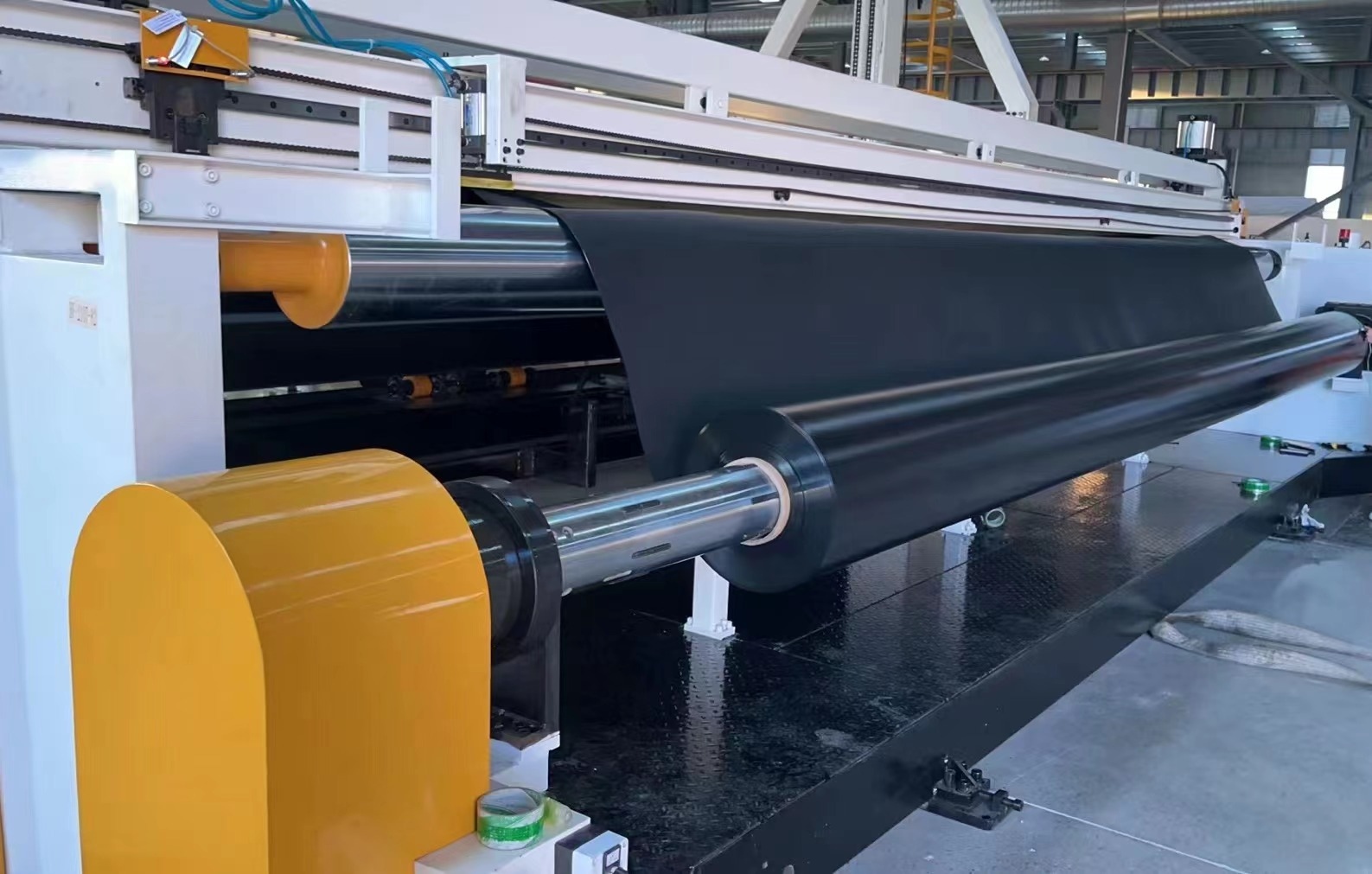
On a slope, the difference between a safe step and a sudden slip often comes down to a few millimeters of raised texture. A smooth surface, no matter how clean, behaves like a sheet of glass once the angle steepens and moisture or dust gets involved. Textured work surfaces are designed to prevent that by giving boot soles something to bite into. The most effective patterns use a mix of sharp-edged ridges and recessed pockets, so each step creates a mechanical interlock rather than relying on friction alone.
On steep embankments, the best textures are not uniform. They combine raised lugs with open channels so water, mud, and loose gravel have somewhere to escape. A waffle pattern alone can clog quickly, but a design that alternates deep grooves with small cross-ribs keeps shedding debris as you walk. Some surfaces borrow from snow tire treads, with siping that flexes open to grip micro-irregularities in the ground. These details matter most when the slope is wet or covered in loose fill, where hydroplaning underfoot is a real possibility.
Materials play an equally important role. Solid metal grating with a rough, sandblasted finish offers durability but can become slippery with ice. Heavy rubber mats with an inverted pyramid texture compress under weight to increase contact area, which works well for temporary work zones. For permanent installations, a concrete surface can be given a broom finish or embedded with silica grit while it is still wet. Whichever option is used, the texture has to be maintained because caked-on dirt or worn-down high points will quietly return the slope to its original danger.
Thickness Isn't Everything: Matching Mil to Chemical Load
A thicker coating often gives a false sense of security. In chemical service, mil thickness alone rarely dictates whether a lining will fail or hold. Two materials can share the same dry film thickness yet behave completely differently when exposed to the same solvent or acid. The real variables are the resin system, cross-link density, and how the coating was cured. A dense, highly cross-linked epoxy at 20 mils can outperform a loosely cured polyester at 40 mils in many aggressive environments.
Matching the material to the chemical load means first characterizing that load accurately. Occasional splash-and-spill exposure is not the same as continuous immersion. Temperature and concentration shift the equation dramatically. A lining that handles 10% sulfuric acid at ambient temperature may soften or blister when the acid is heated or when the concentration swings. Field data and laboratory immersion tests should guide the selection, not just a specification sheet listing mil thickness.
The most durable systems come from balancing thickness with chemical compatibility. Adding more mils of the wrong chemistry simply buys time before failure, and sometimes accelerates it by trapping solvents or creating internal stress. Instead, focus on the permeation rate, the chemical resistance of the binder, and the expected service window. If the load is severe, a thinner but chemically matched coating will consistently beat a thicker generic one.
Conductive Liners When You Need Leak Surveys That Actually Work
A liner that hides leaks defeats its own purpose. Conductive liners change that by giving field technicians a reliable way to locate breaches the moment they happen. The conductive backing turns the entire liner surface into one half of an electrical circuit, so a spark test can pinpoint even pinhole-sized damage that would otherwise go unnoticed until it caused real problems.
What makes these liners different is how they perform under actual site conditions. Instead of relying on visual inspection or random sampling, a properly grounded conductive liner lets you sweep the surface with a detector and get immediate feedback. That means fewer false negatives, less guesswork, and a survey that matches the way containment systems actually get installed: fast, uneven, and rarely picture-perfect.
If your project can't afford the cost of a missed leak, this is the liner specification to ask for. It's not just another add-on. It's the difference between thinking a liner is intact and knowing it is before the cover goes on.
Sunlight, Heat, and Time: Picking a Resin That Won't Embrittle
Resin embrittlement rarely comes from a single cause. Ultraviolet exposure snaps polymer chains at the surface, while sustained heat accelerates oxidation throughout the part. Time acts as a multiplier: a resin that stays flexible for five years in mild conditions can turn brittle in two when parked near a sunlit window or an engine bay. If you need long-term toughness, start with backbone chemistry rather than additives alone.
Aliphatic urethanes and certain cycloaliphatic epoxies resist UV-driven chain scission far better than aromatic epoxies or general-purpose polyesters, which yellow and micro-crack quickly. For continuous heat above roughly 80–90°C, look for resins with high glass transition values but enough crosslink density to avoid excessive stiffness. Blended formulations—such as epoxy-acrylate hybrids or urethane-modified vinyl esters—often preserve flexibility without sacrificing thermal stability.
Additives matter, but they are not a cure. Hindered amine light stabilizers (HALS) and UV absorbers can buy years of outdoor service, yet poorly dispersed or under-dosed stabilizers give false confidence. Ask for real aging data: QUV exposure, thermal cycling, and elongation retention after 1,000+ hours. The best predictor is not the spec sheet headline but how much of its original elongation the resin keeps after the conditions you actually expect.
Field Seams and Anchor Trenches: The Overlooked Durability Factors
Field seams are often treated as a necessary evil during installation, but their long-term performance can make or break a liner system. A weld that looks fine on day one might hide microscopic channels that only open up after years of thermal cycling or uneven settlement. Most failures I've inspected start at the seams, not in the middle of a panel. The problem is that seam quality depends on a dozen variables—surface preparation, ambient humidity, even the speed of the welding technician—that are hard to control on a windy, dusty site.
Anchor trenches don't get much attention either, yet they're the only thing holding the liner in place when the wind picks up or the subgrade shifts. A shallow trench with loose backfill is an invitation for the entire system to creep downhill over time. I've seen trenches that looked solid from the surface but had no compaction at the bottom, leaving the liner free to pull out under tension. The real issue is that these details aren't glamorous, so they get rushed. But a liner is only as durable as its weakest edge.
FAQ
They offer a good balance of flexibility and chemical resistance, so they can handle ground movement and aggressive leachate without cracking. The long-chain polymer structure also gives them better stress crack resistance than HDPE in many situations.
Textured surfaces increase interface friction, which helps keep soil or geotextile layers from sliding on steeper slopes. Smooth liners are easier to clean and inspect, so many designs use textured on slopes and smooth on the floor.
Most durable projects use 40 to 80 mil, depending on subgrade conditions and the stored liquid. A 60 mil liner is common for industrial ponds and landfills, but heavily loaded areas may need 80 mil or a double-liner system.
Hot wedge welding is the standard because it produces consistent double-track seams that can be air-pressure tested. For details and repairs, extrusion welding gives good results but requires careful surface preparation.
They handle many inorganic chemicals, dilute acids, and alkalis well, but concentrated solvents or aromatic hydrocarbons can soften the sheet. Always check chemical compatibility charts for the specific fluid and temperature.
Flexibility lets the liner conform to uneven ground and tolerate differential settlement without bridging or tearing. Very stiff liners may carry tensile loads that concentrate at seams and corners, which shortens the service life.
Anchor trench termination and boot seals around pipes are commonly overlooked. If the liner edge is not properly buried and compacted, wind uplift or runoff can pull it loose, and pipe penetrations are a frequent leak path.
Conclusion
Smooth LLDPE sheet remains a solid default for flat containment basins because it lays out with fewer wrinkles, welds cleanly, and resists punctures from subgrade irregularities. For shallow basins with minimal traffic, a 40-mil smooth liner often outperforms a thicker textured sheet because the uniform surface allows consistent weld pressure and reduces the chance of pinholes at overlap points. Thickness alone won't save a liner from aggressive leachate or acidic process water—matching the mil to the actual chemical load matters more than simply choosing a heavier gauge. Long-term performance also depends on the resin package: additives that absorb UV and heat without migrating to the surface keep the liner flexible after years of direct sun, preventing the brittle cracking that quietly ruins otherwise sound installations.
On steep slopes, textured LLDPE gives workers enough friction to move safely and keeps cover soil from sliding, which is a practical advantage no smooth liner can match. For sites where leak detection is a permit requirement, conductive backing turns the entire liner into a surveyable surface, letting you pinpoint holes that visual inspection would miss. Even the best factory sheet fails early if field seams are rushed or anchor trenches are undercut, so treating weld testing and termination details as part of the specification—not an afterthought—is what separates a durable containment project from one that needs repairs within a few seasons.
Contact Us
Contact Person: Jerry Qiu
Email: [email protected]
Tel/WhatsApp: +65 84265294
Website: https://www.jinseed-geo.com